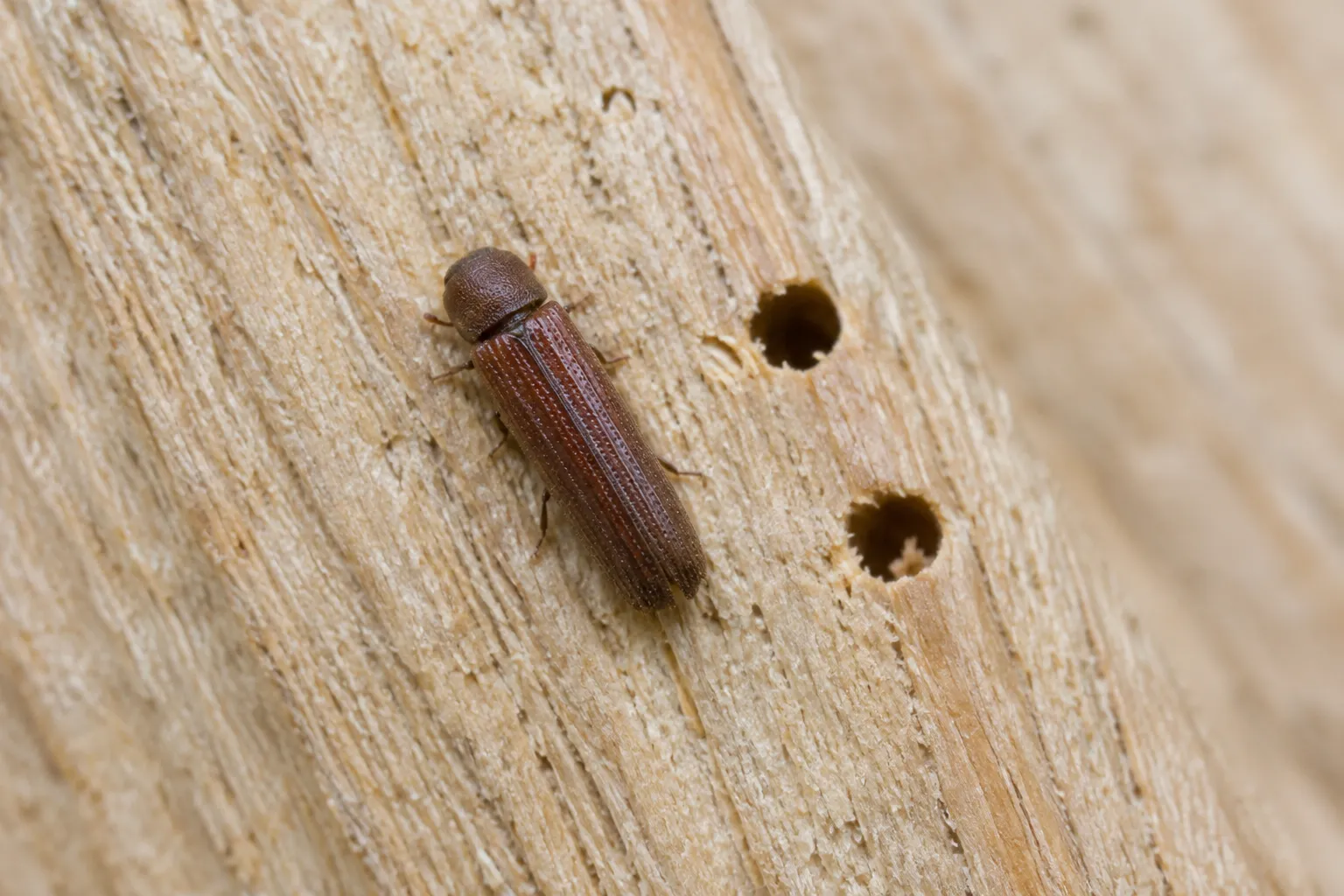
The borer beetle most Auckland homes deal with is the common house borer, Anobium punctatum. It's a small brown beetle, about 3 to 4.5 mm long, whose larvae tunnel through timber for years before the adults chew their way out. You rarely see the beetle. You see its round flight holes and the fine powder it leaves. This page is part of our guide to borer treatment in Auckland. It covers how to identify the borer beetles found in New Zealand houses, how their life cycle works, and how each one is treated.
What does a borer beetle look like?
The common house borer is a small, dark brown beetle, about 2.7 to 4.5 mm long, with an oval body. Its head is hidden under a hood-shaped shell, so from above it looks headless. The adult beetles appear from about October to March, often near windows. The larvae are cream-coloured grubs, up to about 7 mm long, that you only find inside the wood.
Most people never see the larvae. You'd have to break the timber open. What you do see:
- Adult beetles on window sills or in the corners of rooms, in the warmer months.
- Round flight holes about 1 to 2 mm across, where the adults came out.
- Fine, gritty powder (frass) under the holes.
If you find beetles or holes, our page on borer holes helps you work out whether the borer is still active.
Which borer beetles are found in New Zealand homes?
New Zealand has up to seven species of borer, according to Consumer NZ. Three matter most in houses: the common house borer, a native borer that looks very similar, and the two-toothed longhorn. They need the same treatment, but the longhorn leaves bigger holes and stays in the wood much longer.
| Borer beetle | Size and look | Flight holes | When adults come out | Time inside the wood |
|---|---|---|---|---|
| Common house borer (Anobium punctatum) | Small, brown, 2.7 to 4.5 mm | Round, 1 to 2 mm | Roughly October to March | About 2 to 4 years |
| Native house borer (Leanobium flavomaculatum) | Very like the common borer | Round, similar size | Similar to the common borer | Similar |
| Two-toothed longhorn (Ambeodontus tristis) | Long, narrow, with long antennae | Oval, up to about 7 mm | Autumn, about March to May | Several years, longer than the common borer |
The common house borer is the one most often found in homes. It eats the softer sapwood of timbers like untreated pine and older native timbers. The two-toothed longhorn is a native species that can attack heartwood as well. Consumer NZ notes it is less likely to be in buildings, but when it is, the holes are larger and oval.
You'll also hear about the huhu beetle, one of New Zealand's largest longhorn beetles. It isn't one of the common house borers this page is about, so if you think you have huhu grubs in a building, ask a pest control business to identify them.
How does the borer beetle life cycle work?
The borer beetle spends almost all its life as larvae inside the wood. A female lays up to 100 eggs in cracks or old flight holes. They hatch within a few weeks, and the larvae tunnel through the timber for two to four years. They then pupate near the surface, and the adult beetles chew out, mate, lay eggs and die within about a month.
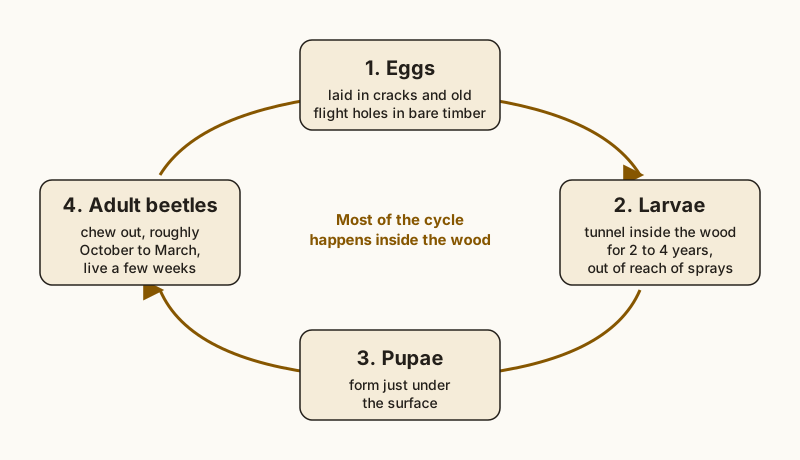
This life cycle explains how borer is treated:
- Eggs go into cracks, joints and old flight holes on bare, untreated timber.
- Larvae feed inside the wood for years, out of reach of most sprays.
- Pupae form just under the surface.
- Adult beetles emerge, roughly October to March for the common borer. They don't feed, and live for only a few weeks.
Because the larvae are protected inside the wood, a treatment has to last longer than they do. That's why a long-lasting residual product on the surface works, and a quick spray in the air does not.
How do you treat a borer beetle?
You treat a borer beetle infestation by targeting the larvae and stopping new eggs. Apply a residual insecticide or preservative to bare timber. Inject flight holes in painted or varnished wood. Have furniture fumigated or injected. Insect bombs and fogging kill only the adult beetles flying around, so they're an extra step during flight season, not a cure.
All three common house species get the same treatment. Where the borer is decides the method:
- Subfloor and roof void timber: a residual spray across the exposed framing. This is usually a professional job, because of the access and the safety gear.
- Floorboards and trim: strip the finish if you can, then treat the bare wood, or inject the holes.
- Furniture: inject the holes, or have a pest control business fumigate the piece.
- Soft, crumbling timber: replace or strengthen it. No treatment makes damaged wood strong again.
Our step-by-step guide on how to treat borer covers each method in detail.
What is a pinhole borer?
"Pinhole borer" usually means an ambrosia beetle. These are small beetles that bore into recently dead, stressed or freshly felled trees and grow a fungus in their tunnels to feed on. They mostly don't eat the wood itself. They make pinholes in logs and green timber, and they're not the borer that keeps eating the dry framing of a house.
If you find pinholes in your house framing or furniture, it's much more likely to be the common house borer, or old pinhole damage that was already in the timber when it was cut. Fresh powder means active borer. Holes with no new powder are often old. A pest control business can confirm which it is.
Questions people ask
How can I get rid of wood-boring beetles?
To get rid of wood-boring beetles, treat bare timber with a long-lasting residual borer product, inject flight holes in painted wood, and fix any damp that drew them in. Bombs and fogging only kill flying adults, so use them only alongside a surface treatment. For a subfloor, roof void or large area, a pest control business will do the job more thoroughly.
What is the best insecticide for borer control?
The best insecticide for borer control is a residual timber treatment made for wood borer. It soaks into bare wood and stays active long enough to outlast the larvae. Products made for injecting flight holes suit painted or varnished timber. Always follow the label. A professional can say which product suits your timber and how long it lasts.
What kind of bugs can cause holes in wood?
Small round holes in wood in a New Zealand home are usually from the common house borer or the very similar native borer. Larger oval holes point to the two-toothed longhorn. Tiny pinholes in logs or green timber are often from ambrosia beetles. Powderpost beetles also make small holes and fine powder, mainly in hardwoods.
Are wood borers as bad as termites?
Wood borers are usually slower than termites. Borer larvae eat timber over years, so damage builds slowly, but an infestation left for decades can weaken floors and framing badly. Exotic termites are rare in New Zealand. They are a notifiable organism, and you must report suspected termites to the Ministry for Primary Industries on 0800 80 99 66.
Do borer beetles bite people or pets?
Borer beetles don't bite people or pets. The adults don't feed at all. They live only long enough to mate and lay eggs. The larvae stay inside the wood their whole lives. The harm borer does is to timber, not to people, which is why the treatment is aimed at the wood.
Sources
Last updated